Home / Blog / Why Ads Manager undercounts your leads
Why Ads Manager undercounts your leads, and what that mistake costs you
Your Facebook and Instagram ads are probably performing better than your dashboard says. That sounds like good news. It is not, and this is the part that catches most owners out.
A cleaning company owner told me his Facebook ads were dead.
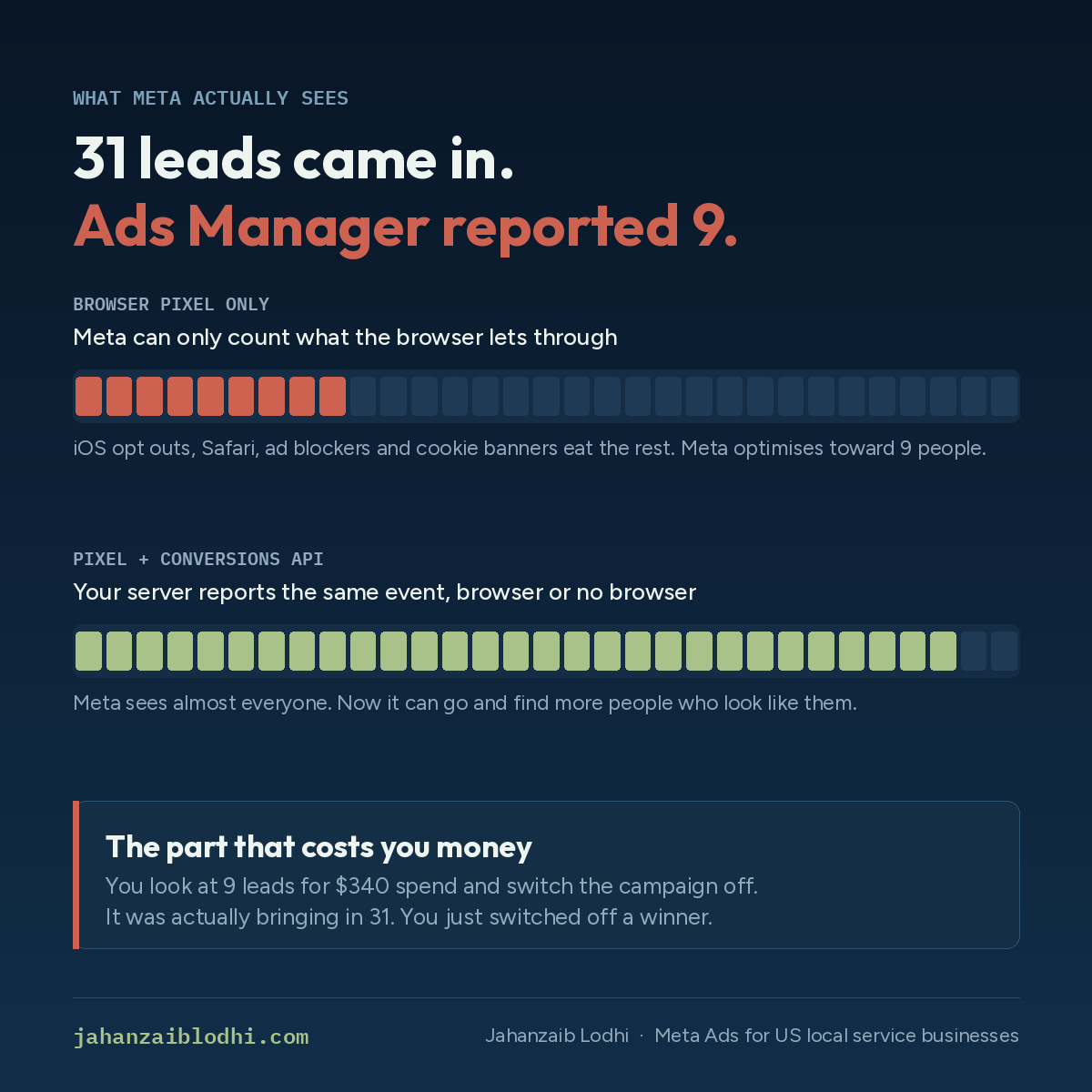
Ads Manager said nine leads. Three hundred and forty dollars spent. He had his hand on the switch and he was about to turn the whole thing off, which is exactly what a sensible person does when the numbers look like that.
I asked him to open his email instead of his Ads Manager. Thirty one enquiries.
Meta was not lying to him. Meta genuinely could not see twenty two of those people. And the gap between what really happened and what the platform could observe is one of the most expensive problems in local service advertising right now, because almost nobody notices it until they have already switched off something that was working.
What Ads Manager is actually counting
The Meta Pixel is a piece of JavaScript that runs in your visitor's browser. When someone submits your form, the Pixel is supposed to fire and tell Meta a conversion happened.
That was a reasonable design in 2018. In 2026 the browser is a hostile place to be doing that job. iOS App Tracking Transparency opt outs, Safari's Intelligent Tracking Prevention, ad blockers, privacy extensions, and cookie banners where the visitor clicks reject all. Every one of those stops the Pixel from reporting.
So the lead still reaches you. The form still submits. The customer still books. The only thing that fails is the message back to Meta saying it happened.
Your dashboard is not measuring your business. It is measuring the fraction of your business that survived the browser.
Why this hurts more than bad reporting
Most people, when they hear about tracking loss, think of it as an accounting problem. The number in the box is wrong, my real results are better, fine.
That underrates it badly, because Meta does not just report on conversions. It optimises toward them.
Meta's delivery system builds a picture of who your buyer is out of the conversions it can observe, then goes and finds more people who resemble them. Show it thirty one real customers and it learns something true about your market. Show it nine, chosen not by who bought but by whose browser happened to allow tracking, and it learns something distorted, then spends the rest of your budget chasing that distortion.
The results genuinely do get worse over time. It is not just the reporting sagging. It is the machine being taught the wrong lesson with your money.
What the Conversions API changes
The Conversions API, usually shortened to CAPI, sends the same conversion event from your server straight to Meta. No browser involved, so nothing in the browser can block it.
The part people get wrong is treating it as a replacement. It is not. You run the Pixel and CAPI together and deduplicate them with a shared event ID, so a conversion that both channels catch is counted once, and a conversion the browser missed still gets through on the server side.
Set up properly, that turns a third of your conversions being visible into nearly all of them. And Meta starts optimising against a real picture of your customer instead of a filtered one.
If you want this fixed without a wider engagement, it is what my Meta setup and rescue exists for.
Tracking on its own books nothing
Here is where I want to be honest, because plenty of people will sell you a CAPI install and let you believe it was the whole answer.
Getting Facebook and Instagram ads to produce booked jobs is a chain with four links. It breaks at whichever one is weakest, and fixing a strong link does nothing at all.
- The campaign gets the right person to click. Creative and offer do most of this work. Targeting matters far less than people think, because Meta's machine learning is already better at finding your buyer than your interest selections are.
- The landing page gets them to submit. Not admire your logo, not read your history. One offer, one form, loading fast on a phone in a driveway with two bars of signal.
- Pixel and CAPI tell Meta it happened. Which is everything above, and it is what makes links one and two compound instead of drifting.
- The follow up reaches them while they still care. A lead contacted in ninety seconds and the same lead contacted nine hours later are not the same lead. By hour nine they have called somebody else.
Most accounts I open are not broken at link one. The targeting is usually fine. They are broken at two, three or four, and the owner has spent months blaming the ads.
How to tell whether this is happening to you
You do not need any tools to run this check. Take last month. Count the actual enquiries that reached you, from your email, your phone, your WhatsApp, your CRM, wherever they land. Then look at what Ads Manager reported for the same period.
If the platform number is meaningfully lower than your real count, you have a measurement gap, and every optimisation decision made in that account since it opened was based on partial information.
For a reference point on what the destination looks like: on a recent Facebook and Instagram build for a cleaning company in Cook County, Illinois, localised campaigns produced 33 leads at $23.90 and 22 at $29.61, inside a portfolio of 451 recorded Meta lead form results. LocaliQ's 2025 benchmark across 3,211 US campaigns puts residential cleaning near $47 per lead on Google Search, and a metro as competitive as Chicago runs higher still.
Those numbers are only trustworthy because the tracking underneath them was reporting properly. Cost per lead measured through a broken Pixel is a number about your visitors' browser settings, not about your marketing.
Common questions
Why does Ads Manager show fewer leads than I actually received?
The Pixel runs in the visitor's browser, and iOS opt outs, Safari, ad blockers and cookie banners all stop it firing. The leads still reach you. They just never reach Meta.
Do I really need the Conversions API, or is the Pixel enough?
The Pixel alone has not been enough since roughly 2021. Run both, deduplicated with a shared event ID, so a blocked browser event still gets reported by your server.
Is this only a reporting problem?
No, and that is the important part. Meta optimises delivery toward the conversions it can see, so incomplete data actively teaches it to find the wrong people.
How quickly should I follow up on a lead?
Minutes, not hours. Automating first contact is usually a bigger win than any targeting change you could make.
Can I check this myself before hiring anyone?
Yes. Count your real enquiries for last month and compare them to what Ads Manager reported for the same dates. The gap is your answer.
Want me to look at yours
A free twenty minute call, screen shared. I go through your Facebook and Instagram ads with you and tell you what I would fix. You keep that list whether you hire me or not, and there is no deck.